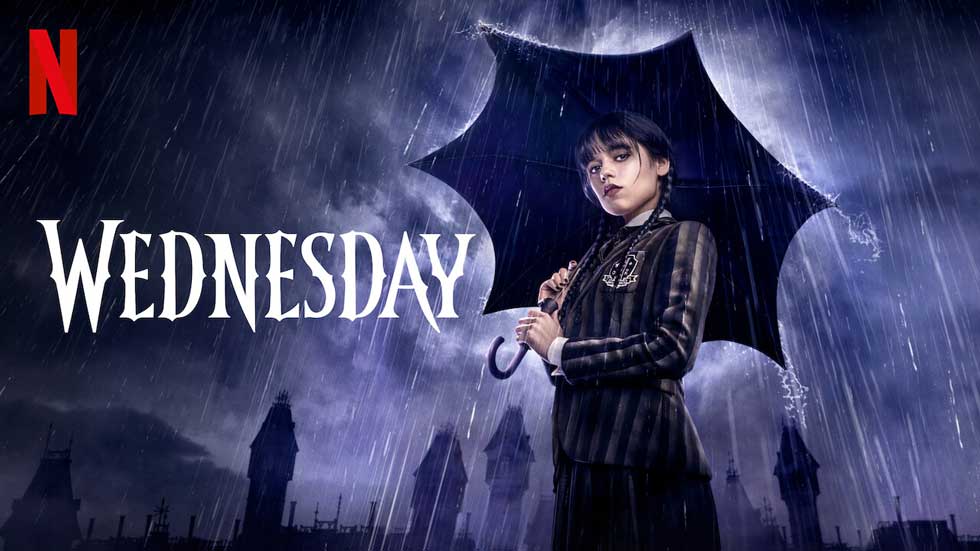
Wednesday – Review

Snap, Snap – The Addams Family Goes Gothic YA

Everybody’s favourite spooky family gets the Tim Burton treatment in Wednesday, Netflix’s sleek, gothic teen mystery set in a school for supernatural misfits. And honestly? I didn’t hate it.

While Burton may have softened since his Nightmare Before Christmas and Edward Scissorhands heyday, his stylistic fingerprints are all over this show—from the towering architecture of Nevermore Academy (shot in Romania, a perfect gothic backdrop) to the pale complexions, looming shadows, and deadpan one-liners. It’s creepy, kooky, mysterious, and spooky… mostly.

The real triumph here is Jenna Ortega’s Wednesday. She’s insufferably miserable in all the right ways—stone-faced, sharp-tongued, and oddly magnetic. Ortega doesn’t just imitate the character, she inhabits her with a fresh confidence, balancing the iconic bleakness with enough vulnerability to make her evolution feel earned. Watching her butt up against cheerful werewolf roommate Enid, overbearing adults, and awkward teenage suitors is a highlight. These collisions force Wednesday to (grudgingly) grow, and it’s deeply satisfying to watch.

That said, some of the original Addams charm is lost in translation. The show suffers from a noticeable lack of Gomez and Morticia, whose romantic, macabre energy gave the earlier versions of the family their heart. Luis Guzmán and Catherine Zeta-Jones do what they can, but they’re sidelined in favor of a Hogwarts-meets-Riverdale teen plot that, while entertaining, feels slightly overstuffed. The ancestral haunting subplot had the bones of something brilliant—it felt thematically in step with the Addams’ legacy—but the show’s insistence on playing it overly straight zaps some of the fun. A touch more self-awareness or camp might have balanced the tone better.

Still, the supporting cast shines. Emma Myers’ Enid is an absolute delight, balancing bubbly optimism with genuine emotional depth. Gwendoline Christie’s Principal Weems commands every scene with elegance and menace, and Hunter Doohan as Tyler does a commendable job walking the line between charm and deception. Then there’s Christina Ricci—returning to the Addams universe not as Wednesday, but as a teacher with secrets of her own. Her performance is both nostalgic and shrewd. Yes, her villainy is clearer on rewatch, but Ricci’s natural likability keeps you guessing, making the eventual reveal genuinely effective.

Visually, the show is gorgeous. The Romanian setting gives the show a real sense of place—misty forests, looming buildings, and dark corners that feel like they were pulled from a gothic fairytale. It’s the perfect frame for Wednesday’s grim worldview.

In the end, Wednesday is a stylish, slightly uneven, but thoroughly watchable reimagining of a classic. It’s less a love letter to the Addams Family and more of a spin-off that dabbles in the macabre while firmly planting itself in the YA genre. If Burton’s edge has dulled, Ortega sharpens it again with a performance that’s as cold and cutting as it is compelling.

A Series of Unfortunate Events

In celebration of me just finishing the new Netflix version of ‘A Series of Unfortunate Events’ I decided my first post would be of Lemony Snicket’s book series. These books were the first real series I read. Previously I mainly read Roald Dahl and Jacqueline Wilson, but as I got to age eleven I wanted more intricate stories, and Lemony Snicket (Daniel Handler) delivered. I was always a fan of stories that felt as though the had a real conflict, like life or death situations. Therefore ‘The Witches’ was my favourite of Roald Dahls. When I found ‘A Series of Unfortunate Events’ I could not put it down. I remember thinking the plot was so clever, the writing style was awesome, and I loved how the author became a character in the story. I also remember thinking book eight was my favourite, so it’ll be interesting to see whether that is still the case!

Time to re-read!

Now, I must confess I did not fully re-read all these books (there’s thirteen altogether)! Starting at the beginning, the writing style is as amazing as I remember. It’s so engaging, especially for someone aged ten/eleven who is furthering their reading ability. The inclusion of more complicated words, along with a usually witty explanation makes me wonder if these books are used in schools. Because they should be! I think one clever element of the actual story is that the Baudelaire orphans begin with Count Olaf as a guardian. It would perhaps be easier, although lazier, to simply have him chase them from place to place. However, in having him be the first guardian the reader gets so well acquainted with the antagonist to the point where, and apologies for skipping ahead, the ending of the series feels quite moving! I’d forgotten about the ‘Dear Editor’ notes at the end of each book. These are very effective ways of increasing the readers want to read the next book. Always styled differently to suit the themes of the following chapter, they work so well with the overall tone of someone researching these events. I can see why book eight would have been my favourite as a twelve-year-old as it is the first book in which the Baudelaires venture out alone without Mr Poe and in hiding from the world, as they are suspected murderers. As a ‘tween’ there is nothing more appealing than freedom and out-smarting adults! As an adult reader, the stylised writing and the repetition of tropes and themes does become some-what tedious toward the end. These things are understandably needed with the target audience, however, as it allows the plot to stay directly in the readers mind and the pace to remain snappy, for the shorter attention spans. Upon reading it again, I relate much more to Klaus than Violet, who I related to upon first reading it. This is not surprising to me, Klaus’s methods for problem solving and his interest in books fit my personality far more than the hands-on approach of Violet.

This is a side note comparing the book series to the Netflix series and the 2004 film adaptation. The film, although focuses only on the first three books and changes the plot quite significantly to fit, is very entertaining. The cast is great, and Jim Carrey does an excellent job of undercutting the evilness of Olaf with comedic moments. I also love the inclusion of Jude Law as Lemony, his voice is perfect for narration and, as a Brit myself, it is much more how I imagined the character to sound. I’m not sure if this is an unpopular opinion, but I prefer the Netflix series overall. Not only because it covered the entire plot of all thirteen books, but I think it is a much more accurate representation. The cartoon-like style of the set reflects the hyperbolic language used throughout the books, while also being very visually appealing. Neil Patrick Harris’ version of Olaf is far more what I imagined from the books also. He brings the theatricality of the role more into play, of course. Furthermore, his Olaf is more pitiful than the films portrayal. A key aspect of Olaf that the books included making him a more layered and interesting antagonist.

Overall, these books are as great as I remember them to be! I would recommend them to all ages, but with a reminder that they are written for a younger reader. I think there should be more children’s fiction that is willing to be this dark, because it holds so many important messages, without spoon-feeding them. I’d say my favourite, upon re-reading, is book seven. ‘The Vile Village’ is a turning point in the series. It also introduces the Snicket family into the story, and the whole plot just becomes more intricate. I also love the whole visual of town run by idiotic adults and the images of the crows and the couplet clues from two of the triplets. This book just helps cement the series in the mystery genre. In my humble opinion, these books allow their plot to grow alongside their characters and their audience (usually), making them perfect for any young readers.

Favourite Quote: “Well-read people are less likely to be evil.” (The Slippery Slope)

Second Favourite Quote: “If you are allergic to a thing, it is best not to put that thing in your mouth, particularly if the thing is cats.” (The Wide Window)

(I am indecisive, sorry.)