Chuck Chuck Baby – Review

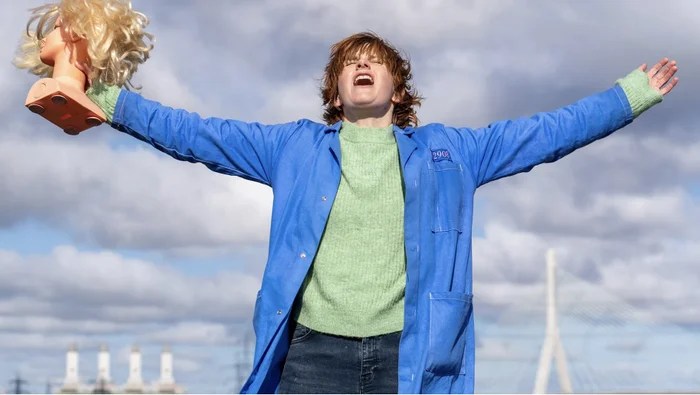
Chuck Chuck Baby is a tender, offbeat gem of a film that blends the grit of working-class life with the sparkling charm of a jukebox musical, delivering a heartfelt coming-of-age story about starting over—particularly from the queer, female perspective.

At its core is Helen, played with aching vulnerability and quiet strength by Louise Brealey. Her journey of self-discovery and reconnection is both specific and universal, deeply rooted in the common queer experience of having to rebuild and rediscover oneself later in life. The arrival of her old flame, Joanne (a magnetic performance by Annabel Scholey), acts as a catalyst, unlocking memories, regrets, and new hope. Their chemistry crackles—playful, intimate, and electric without ever feeling forced. Watching them together is a genuine joy.

What makes Chuck Chuck Baby stand out isn’t just its heartfelt narrative but the way it dares to contrast its bleak, industrial setting with moments of unfiltered whimsy. Set against the grey backdrop of a chicken factory, the film sprinkles in delightfully kooky musical numbers. It’s a melting pot of the weird and the utterly mundane and that tonal contradiction reflects Helen’s emotional landscape as she stumbles toward rediscovery.

The wider ensemble of factory workers forms an unlikely but deeply affecting surrogate family. Their camaraderie, bickering, and quiet acts of care become the beating heart of the film. It’s through them that Chuck Chuck Baby reveals its central message: that love, in all its forms, is what gives life colour.

Musically, this is a jukebox musical like nothing I’ve ever seen. The opening number immediately brought to mind the iconic “Wild World” scene from Skins—unpredictable, raw, and beautifully staged. But it was Helen losing herself to Neil Diamond’s “I Am… I Said” that absolutely floored me. It’s one of those rare cinematic moments that’s simultaneously hilarious and heartbreaking.

I laughed out loud. I cried. And really, what more can you ask for than that?

Rivals – Review

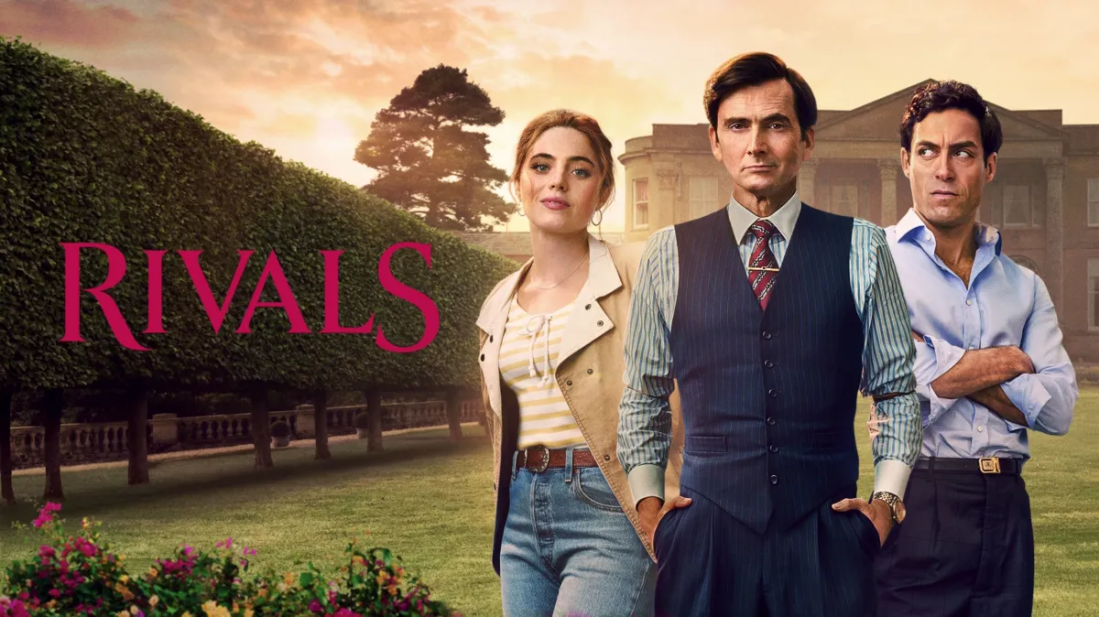
With Rivals, Disney+ delivers a delicious slice of glossy, high-octane escapism that whisks you straight into the decadent heart of 1980s Rutshire—a fictional English county where ambition, power, and scandal rule. Adapted from Jilly Cooper’s beloved series, this show is Bridgerton with perms and leg warmers. It is unapologetically indulgent and impossible to look away from.

As we follow Declan O’Hara and his family into this gaudy, glamorous world, the real one fades to static. With every slow pan across a country estate or shoulder-padded boardroom, you feel the shift—you’re no longer in your living room, you’re in the inner circle. The production design leans into 80s maximalism with flair giving it a larger than life feeling.

At the heart of it is the Gatsbian rivalry between David Tennant’s magnetic Tony Baddingham and Alex Hassell’s suave Rupert Campbell-Black. Their feud—new money versus old money, populist grit versus aristocratic polish—is both classic and sharply drawn. Tennant is clearly having the time of his life, chewing scenery with the kind of unhinged charisma that only he can deliver. Hassell, meanwhile, oozes the kind of charm that makes you hate yourself for loving him.

Yes, it’s sexy, but that’s not what makes Rivals so addictive. What hooks you, episode after episode, is the sheer fantasy of it all—the illusion of being in a world where everything is brighter, bolder, and drenched in glamour. For an hour, you’re not doomscrolling or doing laundry—you’re wrapped in fur, sipping champagne, plotting rival takeovers with a smirk.

The Princess Diaries

A seminal classic to this day! The Princess Diaries had been seen by almost everyone I knew. The combination of Hathaway and the Queen of Genovia herself Julie Andrews, was a match made in teenage-girl heaven. Plus, the story itself is so appealing to most people of that age. That someone comes into their lives and tells them they are heir to a throne. Most teenagers deal with feelings of unimportance as you grow and begin to realise that it isn’t all about you. So, The Princess Diaries presents a most appealing idea that someday someone will tell you, you are important. Perhaps that’s a slightly dim take on it.

On that note, time to re-watch!

Although I can tell she is younger, Anne Hathaway honestly hasn’t changed that much, looks wise. I completely forgot Mandy Moore was in this! All I can see is Rapunzel now. I am struggling with this make-over scene. I understand the importance of posture and such, but it feels a little like it could verge on the wrong message. That in order to be successful you must look a certain way. I suppose it is true in essence, I mean we never see the Royal Fam with unkempt hair and eyebrows. I’m pretty sure I heard that the slip Mia has on the steps was a real blooper they just decided to keep in. That’s a nice element to the film. All of the people in her school kind of suck. Even her best friend, Lily, is pretty self-involved. I know it’s a comedy, so the teachers/adults can be a little out-there, but they could have made her friend more likeable. I suppose the love interest, Michael not the other guy, is a nice character. During the beach party scene Mia is dressed in a purple top, green skirt and has red flip flops which are giving me major Ariel vibes. I’m not sure if this is intentional, I don’t know why it would be, but it is Disney and she is a princess. I may start some kind of conspiracy theory here. Maybe her Dad isn’t really dead, maybe he’s ruling the sea. Anyway, back to earth brain. I am fairly sure when I first watched this I thought Genovia was a real country. Upon a quick Google search, it appears I was not alone! I really like the speech Mia gives upon accepting her role. It does go back to what I said in the introduction, before I re-watched, about the part of growing up that is realising you’re not the only person that matters. I feel like that would have been a stronger ending than the completion of the love interest story-line but it’s a teen film so it’s to be expected. Overall, this film is still highly enjoyable despite some clichés. Remember, this is all just my humble opinion.

Favourite quote: No one can make you feel inferior without your consent.

Angus, Thongs and Full-Frontal Snogging

A staple found upon the shelf of many British teenage girls many years ago, including my own. There was nothing better than getting hold of the next book in the series, finding out what Georgia had gotten up to and gossiping about it with friends. Well, at least this is what me and my friends did.

Before we get into the book review I’m going to recall the things I remembered about this series from when I first read it. I remember obsessing over the snogging scale and giggling every time I read ‘The Full Monty’. You were either Team Dave the Laugh or Team Robbie. It was the original Edward/Jacob some may say. I also remember being scandalised by the ending. I’m excited to pick these books back up!

Time to re-read!

My immediate thought was, how did I completely forget this was a diary? It is written as a pretty realistic teenage diary as well. With Georgia checking in, sometimes minuets after the previous entry, due to boredom, with a random thought. Some of the cultural references definitely date this book. I’m not even sure what ‘Noel’s House Party’ was? To Google! Oh, it’s Noel Edmunds with Mr Blobby. Duhhh! (That’s right, I’m bringing back ‘duhhh’!) Wow, there are a lot of references to Nazi Germany in this book. I’m not even sure I would have picked up on those as a thirteen-year old. Rennison’s use of slang, over-generalisations and hyperbole are perfect for creating a realistic teenage character. I know at the time I originally read this, I would have agreed with a lot of what Georgia was saying/worrying about. As an adult it all seems quite pitifully funny, like reading your younger cousins diary and saying ‘aw honey’ in an extremely condescending manner.  Overall, the books are still very funny, light reading but not something I see myself reading again. The teenage aspect is quite intense and that’s just not for me at this stage in my life! However, I can fully understand why these were my favourite books when I was thirteen. The way Rennison writes is so inclusive, the reader understands the inside jokes and you feel as though you’re part of the ‘Ace Gang’.

Angus, Thongs and Perfect Snogging: film.

With a slightly altered title, Angus came to the big screen. Thirteen-year-old me was THRILLED. I remember going to watch it in the cinema with my friends and cringing hard when the snogging/saliva scene came on. A slightly embarrassing truth here is that until about the age of sixteen, I used to get up extra early before school and watch this film. Everyday. I can still quote most of it now. To say I was obsessed is a fair judgement, to say I was insane is probably quite fair as well. It was one of the first films I ever watched the director’s commentary for. (I think the very first was Nanny McPhee) This is perhaps what began my obsession with films and film-making. One piece of useless trivia I remember from my many viewings of this was that seagulls would not co-operate, so the props department bought a very realistic fake seagull and it ended up being one of the most expensive props.

Time to re-watch!

One of my immediate thoughts is how awesome the soundtrack is! I also forgot how funny the parents are in this film! I mean they are both comedians, but they play slightly embarrassing parents very well. These girls, the Ace Gang, are creepier than I remember. Stalking and watching someone in their house with binoculars. I don’t remember ever doing anything like that as a teen! I love the setting of Eastbourne, it is very ascetically pleasing as a backdrop throughout. Robbie does not hold back on telling Georgia off! I think that’s one of the best parts of the film. The protagonist getting her comeuppance, though only for a short time. The overall story arch of this film, though differing from the books, is fairly predictable but still satisfying. Georgia learns her lesson, has a great birthday party and gets a boyfriend. The ultimate happy ending for fifteen-year-olds I guess. I suppose one of the main reasons the plot differs to much from the first book is that, due to the diary format, there’s not a satisfying story arch that is needed for screen.

Favourite Quote: I wrote a song about you. It’s called ‘Bitch in a Uniform’.